Thomas Cranmer: Architect of the English Reformation
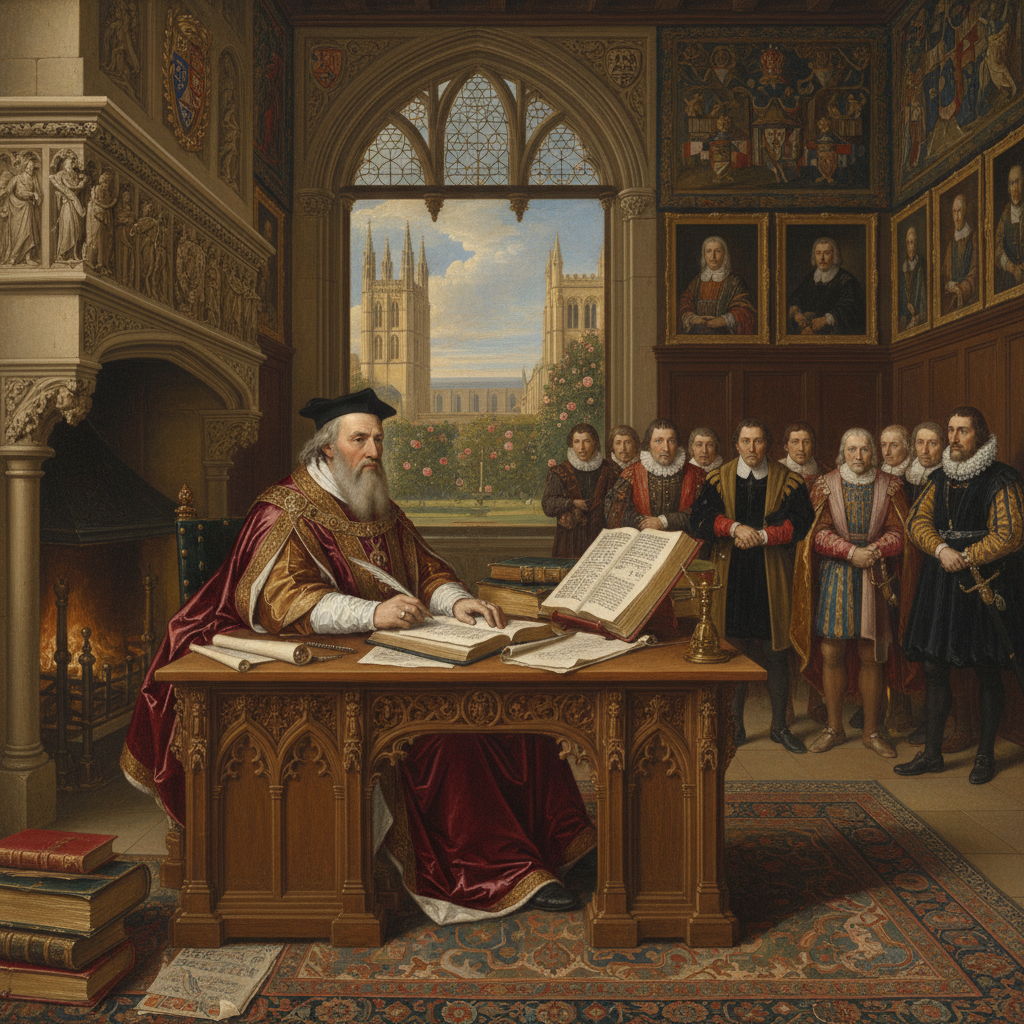
In the tumultuous tapestry of Tudor England, few figures cast a shadow as profound and enduring as Thomas Cranmer. More than just an Archbishop, Cranmer was the theological architect of the English Reformation, a man whose quiet scholarship and unwavering conviction fundamentally reshaped the spiritual and political landscape of a nation. From his pivotal role in Henry VIII's 'Great Matter' to his tragic martyrdom under Mary I, Cranmer's journey is a compelling narrative of faith, power, and the relentless pursuit of religious truth. His legacy, etched into the very fabric of the Church of England, continues to resonate, inviting us to delve into the life of a scholar who became a reluctant revolutionary.
The Scholar's Ascent: From Cambridge to Court
Born in Aslockton, Nottinghamshire, in 1489, Thomas Cranmer's early life was marked by academic pursuits rather than political ambition. He studied at Jesus College, Cambridge, where he immersed himself in theology, patristics, and the burgeoning humanist thought of the era. His intellectual prowess was undeniable, yet his path to prominence was initially slow and steady, far removed from the glittering courts of power.
Cranmer's destiny irrevocably shifted when he became embroiled in King Henry VIII's desperate quest for an annulment from Catherine of Aragon. While staying with relatives to avoid the plague, Cranmer's casual conversation with two of the King's advisors, Stephen Gardiner and Edward Foxe, led to a revolutionary suggestion: why not consult the universities of Europe on the legality of the King's marriage, rather than relying solely on the Pope? This audacious idea, suggesting that the matter was one of divine law rather than papal dispensation, instantly caught Henry's attention. The King, notoriously impatient and eager for a solution, reportedly exclaimed, "This man hath the sow by the right ear!"
Suddenly, the unassuming Cambridge don was thrust into the heart of the 'Great Matter.' He served as an ambassador to Emperor Charles V and later to the German Protestant princes, where he secretly married Margaret, the niece of a prominent Lutheran theologian. This marriage, a direct violation of clerical celibacy, underscored his growing reformist sympathies even before his elevation to the highest ecclesiastical office in England.
Archbishop of Canterbury: Forging a New Church
In 1532, against his own initial reluctance and despite his secret marriage, Henry VIII appointed Cranmer as Archbishop of Canterbury. The King knew he needed a pliable, yet intellectually formidable, figure to navigate the treacherous waters of his divorce and the subsequent break with Rome. Cranmer proved to be both. He swiftly declared Henry's marriage to Catherine invalid and his marriage to Anne Boleyn legitimate, paving the way for Elizabeth I's birth and solidifying the King's supremacy over the Church in England.
Cranmer's tenure as Archbishop was characterized by a meticulous, often cautious, approach to reform. While Henry VIII was primarily concerned with political and dynastic matters, Cranmer harbored genuine theological convictions that leaned towards Protestantism. He skillfully navigated the King's fluctuating theological whims, gradually introducing reforms that moved the English Church away from Roman Catholicism. His influence was most profoundly felt in two key areas:
- The English Bible: Cranmer passionately advocated for the Bible in the vernacular. He played a crucial role in the production and distribution of the Great Bible (1539), ensuring that every parish church had a copy for public reading. This act was revolutionary, empowering ordinary people to engage directly with scripture.
- Liturgical Reform: Cranmer's masterpiece, the Book of Common Prayer, first published in 1549 during the reign of Edward VI, was a work of unparalleled theological and literary genius. It replaced the complex Latin rites with a single, unified English liturgy, making worship accessible and comprehensible to the common worshipper. Its poetic language and theological precision shaped English spirituality for centuries.
"Forasmuch as the King's Majesty, by the advice of his most honourable Council, hath ordered that the Bible shall be set up in all parish churches throughout this his realm... I exhort you, and require you in God's name, that you and every one of you, do your diligence to provide one of the said Bibles." - Thomas Cranmer, Injunctions to the Clergy, 1538.
Theological Evolution and Persecution
Cranmer's theological journey was one of continuous evolution. Initially holding views closer to traditional Catholicism, his studies and interactions with Continental reformers like Martin Bucer and Peter Martyr Vermigli gradually led him to embrace more distinctly Protestant doctrines, particularly regarding the Eucharist. Under the young, devoutly Protestant Edward VI, Cranmer was finally able to implement more radical reforms, culminating in the second Book of Common Prayer in 1552, which presented a clear Protestant theology.
Did You Know?
Thomas Cranmer was a prolific letter writer. His letters provide invaluable insights into the political and religious machinations of the Tudor court, often revealing his personal anxieties and strategic maneuvering to advance the Reformation while navigating the dangerous whims of Henry VIII.
However, the accession of the staunchly Catholic Mary I in 1553 brought an abrupt and brutal end to the Protestant reforms. Cranmer, as a key architect of the break with Rome and the annulment of Mary's mother's marriage, was immediately targeted. He was imprisoned, subjected to lengthy trials, and pressured to recant his Protestant beliefs. Under immense duress, and hoping to avoid the horrific death by fire, Cranmer signed several recantations, publicly denying his Protestantism and affirming Catholic doctrine.
Martyrdom and Enduring Legacy
Despite his recantations, Mary I and her advisors were determined to make an example of him. On March 21, 1556, Thomas Cranmer was led to the stake in Oxford. In a moment of profound courage and defiance, he dramatically repudiated his recantations, declaring his true faith. As the flames rose, he famously thrust his right hand, which had signed the recantations, into the fire first, crying, "This hand hath offended!" His martyrdom, alongside those of Hugh Latimer and Nicholas Ridley, solidified his place as one of the 'Oxford Martyrs' and a hero of the English Reformation.
Cranmer's death was a tragic end to a life dedicated to shaping the English Church. Yet, his legacy profoundly outlived him. When Elizabeth I ascended the throne, she largely restored the Elizabethan Religious Settlement, which drew heavily on Cranmer's liturgical work and theological principles. The Book of Common Prayer, in particular, became the bedrock of Anglican worship, its language and structure influencing countless generations. His vision for a reformed, English-speaking church, rooted in scripture and accessible to all, ultimately triumphed.
Thomas Cranmer remains a complex and often debated figure. Was he a weak-willed opportunist, bending to the will of powerful monarchs? Or was he a shrewd theologian, patiently and strategically guiding England towards reform through perilous times? Perhaps he was both. What is undeniable is that his intellectual prowess, his deep conviction, and his ultimate sacrifice indelibly marked the religious landscape of England. His work continues to shape the identity of the Church of England and stands as a testament to the power of ideas in an age of profound upheaval. Exploring Cranmer's life is to understand the very foundations of modern Anglicanism and the enduring spirit of the English Reformation.
TAGS
Discussion
No comments yet
Be the first to share your thoughts on this article!
You May Also Like
Continue exploring Tudor history with these related articles

Catherine of Aragon: The Spanish Princess Who Defined the Tudor Era
Explore the life of Catherine of Aragon, the Spanish Infanta whose marriage to Henry VIII and subsequent refusal to accept an annulment triggered the English Reformation and defined the Tudor era.

The Sickening Truth: Medicine and Health in Tudor England
Dive into the precarious world of Tudor medicine, exploring the reliance on the Four Humours, the terrifying reality of the plague, and the often-dangerous treatments used by physicians, surgeons, and apothecaries in 16th-century England.

The Boleyn Ascent: How a Norfolk Family Conquered the Tudor Court
Explore the astonishing three-generation rise of the Boleyn family, from ambitious London merchants to the pinnacle of power, culminating in Anne Boleyn's controversial queenship and the English Reformation.

The Majesty and Mystery of Tudor Gardens and Landscapes
Explore the sophisticated world of Tudor gardens and landscapes, revealing how these meticulously designed spaces served as powerful symbols of status, utility, and Renaissance order during the reigns of Henry VIII and Elizabeth I.