Ink and Intrigue: The Golden Age of Tudor Literature and Poetry

The Tudor era (1485–1603) was not merely a time of political upheaval, religious reformation, and dynastic drama; it was a vibrant crucible for the English language and literary expression. As the Renaissance swept across Europe, it found fertile ground in England, transforming poetry, prose, and drama from medieval forms into sophisticated, modern art. The court, especially under Henry VIII and Elizabeth I, became a crucial patron, fostering a culture where wit, rhetoric, and mastery of verse could lead to social advancement, or, conversely, political ruin. To study Tudor literature is to gain a direct window into the minds, anxieties, and aspirations of this transformative age.
The Dawn of English Renaissance: Poets of the Early Tudor Court
The literary landscape of the early Tudor period was dominated by figures who bridged the gap between the medieval tradition of Chaucer and the burgeoning classical influence. The introduction of the printing press by William Caxton in the late 15th century had already begun to democratize knowledge, but it was the poets themselves who refined the tools of the trade.
Sir Thomas Wyatt and Henry Howard, Earl of Surrey: Revolutionizing English Verse
Two figures stand paramount in initiating the English poetic Renaissance: Sir Thomas Wyatt the Elder (1503–1542) and Henry Howard, Earl of Surrey (1517–1547). Both men were courtiers, diplomats, and tragically, victims of the volatile Tudor political machine. They are credited with introducing the sonnet form—a structure perfected by Petrarch in Italy—to England, adapting it with remarkable skill.
Wyatt, often linked romantically (and perilously) to Anne Boleyn, used the sonnet to explore intense personal emotion, particularly the frustrations and dangers of courtly love. His famous poem, ‘Whoso list to hunt,’ is widely interpreted as a veiled warning about pursuing Anne Boleyn, whom he describes as ‘Caesar’s,’ referring to Henry VIII.
Surrey, however, made the more significant technical contribution. While Wyatt translated Petrarch’s structure directly (the Italian or Petrarchan sonnet), Surrey developed the structure we now know as the English or Shakespearean sonnet (three quatrains and a concluding couplet). More crucially, Surrey invented blank verse—unrhymed iambic pentameter—which would become the standard meter for English dramatic poetry, including the works of Marlowe and Shakespeare.
“A careful mind, with fear oppressed, doth follow the chance, and hath no power to start.”
— Sir Thomas Wyatt, reflecting on the dangers of court life.
Did You Know?
Despite their immense influence, the works of Wyatt and Surrey were not widely published during their lifetimes. They circulated primarily in manuscript form among the educated elite. It was only after their deaths, in the influential 1557 collection Tottel's Miscellany (Songs and Sonnets), that their poetry reached a wider audience, cementing their status as the fathers of modern English verse.
The Elizabethan Zenith: Literature as National Identity
Under Elizabeth I, literature flourished into a golden age. Stability, patriotic fervour following the defeat of the Spanish Armada, and the Queen’s own intellectual curiosity provided the perfect environment for unprecedented creativity. The focus shifted from purely courtly concerns to broader philosophical, historical, and dramatic themes.
The Rise of Prose and Pamphleteering
While poetry soared, prose also matured significantly. The need for religious and political commentary during the Reformation spurred the growth of pamphlets and polemics. Figures like John Foxe, whose Actes and Monuments (or Foxe’s Book of Martyrs) detailed the persecution of Protestants, shaped public opinion profoundly. This era also saw the birth of early English novels, such as John Lyly’s highly influential Euphues: The Anatomy of Wit (1578), known for its elaborate, antithetical prose style that momentarily captivated the court.
- Key Prose Developments:
- The establishment of modern English grammar and vocabulary.
- The popularity of travel narratives (e.g., Richard Hakluyt’s Principal Navigations).
- The rise of literary criticism and treatises on rhetoric.
Edmund Spenser and the Epic Tradition
No Elizabethan poet better embodied the era's ambition than Edmund Spenser (c. 1552–1599). His monumental allegorical epic, The Faerie Queene, dedicated to Elizabeth I, was intended to be the great national poem of England, rivalling the works of Homer and Virgil. Though unfinished, its six books celebrate Protestant virtues and Tudor mythology, using a complex nine-line stanza (now known as the Spenserian stanza) that showcases incredible linguistic richness and musicality.
“Fierce warres and faithful loves shall moralize my song.”
— Edmund Spenser, opening line of The Faerie Queene.
Spenser’s work was deeply political, subtly advising the Queen while simultaneously glorifying her reign, demonstrating how literature served as a vital tool for constructing Tudor national identity and propaganda. His poems are essential reading for understanding the moral framework of the late Tudor period.
The Literary Legacy of the Late Tudors: Preparing for Shakespeare
The final decades of the Tudor dynasty saw an explosion in drama, but also a refinement of lyrical poetry that paved the way for the Jacobean era. This period is characterized by intense intellectual curiosity and a growing skepticism, often reflected in highly personal and sophisticated verse.
Sir Philip Sidney: Poet, Courtier, and Ideal
Sir Philip Sidney (1554–1586) epitomized the Renaissance ideal of the 'universal man'—a skilled soldier, diplomat, critic, and poet. His prose romance, Arcadia, and his critical treatise, The Defence of Poesy, were hugely influential. However, his most enduring contribution is the sonnet sequence Astrophil and Stella (published posthumously), which chronicles the passionate, yet ultimately unfulfilled, love between Astrophil (star-lover) and Stella (star). Sidney’s work injected a fresh, conversational energy into the sonnet form, moving away from the often stiff translations of earlier poets.
The Importance of Patronage and Performance
Tudor literature, unlike today’s mass-market publishing, relied heavily on patronage. Writers needed the financial support of wealthy nobles or the monarch to survive. This system dictated content, ensuring that much of the era’s output was focused on flattering patrons, offering political commentary, or providing entertainment for the elite. The rise of the public theatre in London, however, began to shift the balance, creating a professional class of writers who relied on ticket sales rather than solely on aristocratic favour, leading directly to the theatrical dominance of William Shakespeare, who began his career under Elizabeth I.
Understanding Tudor literature requires acknowledging its dual nature: it was both a high art form practiced by the educated elite and a powerful medium for public discourse and political maneuvering. From the veiled warnings in Wyatt’s sonnets to the epic sweep of Spenser’s allegories, these works provide invaluable insight into the intellectual and emotional life of the Tudor age, laying the definitive foundation for all subsequent English literary history. We encourage readers interested in this topic to explore the fascinating connections between Tudor literature and the history of the English Reformation and the Elizabethan court.
Discussion
No comments yet
Be the first to share your thoughts on this article!
You May Also Like
Continue exploring Tudor history with these related articles

Shakespeare's Tudor World: Drama, Power, and Politics
Explore how William Shakespeare’s life and works were profoundly shaped by the political volatility, religious upheaval, and cultural vibrancy of the Tudor era under Queen Elizabeth I.

Ink, Ideas, and Revolution: The Printing Press in Tudor England
Explore the revolutionary impact of the printing press in Tudor England, from its arrival with William Caxton to its pivotal role in the Reformation and the Crown's attempts at censorship.

The Revolutionary Impact of the Printing Press in Tudor England
Explore how the printing press revolutionized Tudor England, from democratizing knowledge and fueling the Reformation to shaping national identity and literacy.
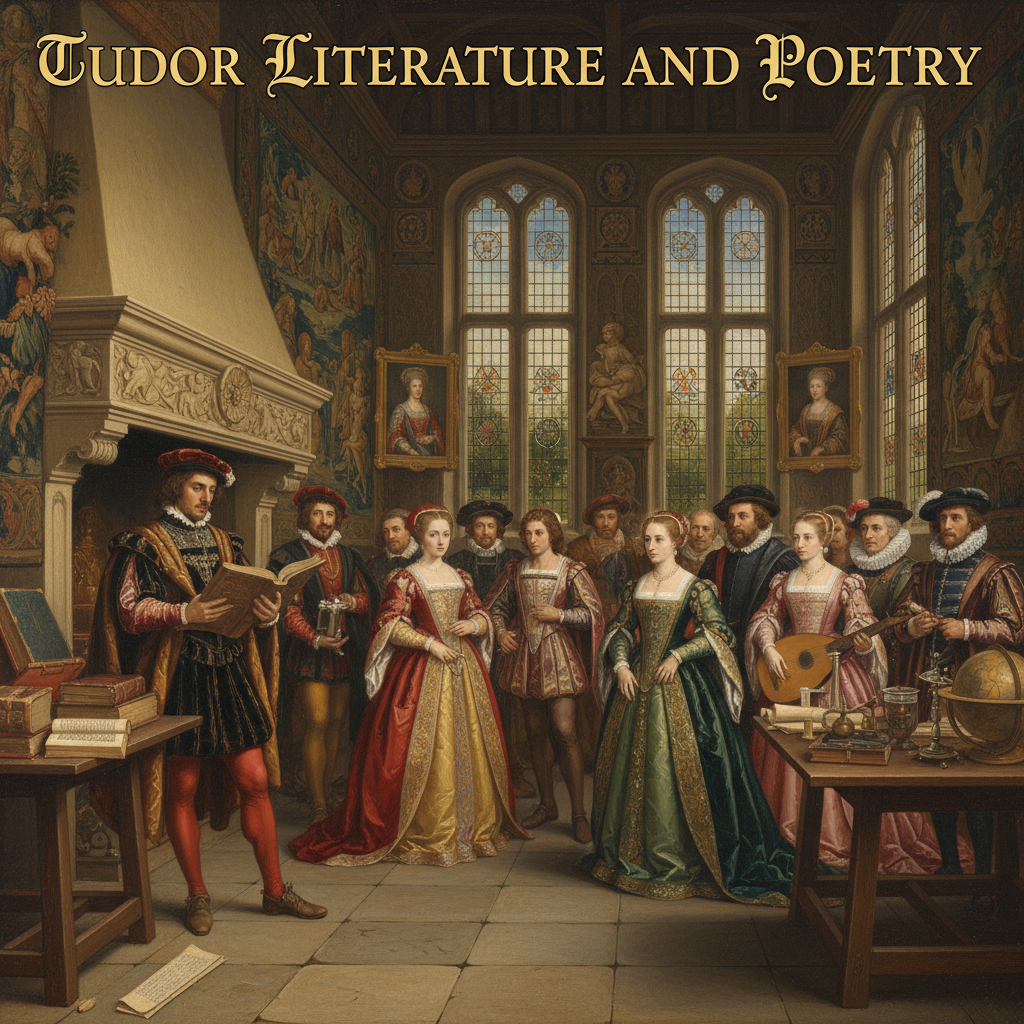
The Golden Age of Words: Tudor Literature & Poetry
Explore the Golden Age of Tudor literature and poetry, from courtly verses and Reformation prose to the dramatic genius of Shakespeare, shaping English language and culture.