Henry VIII's Six Wives: A Complete Guide to Tudor Queens
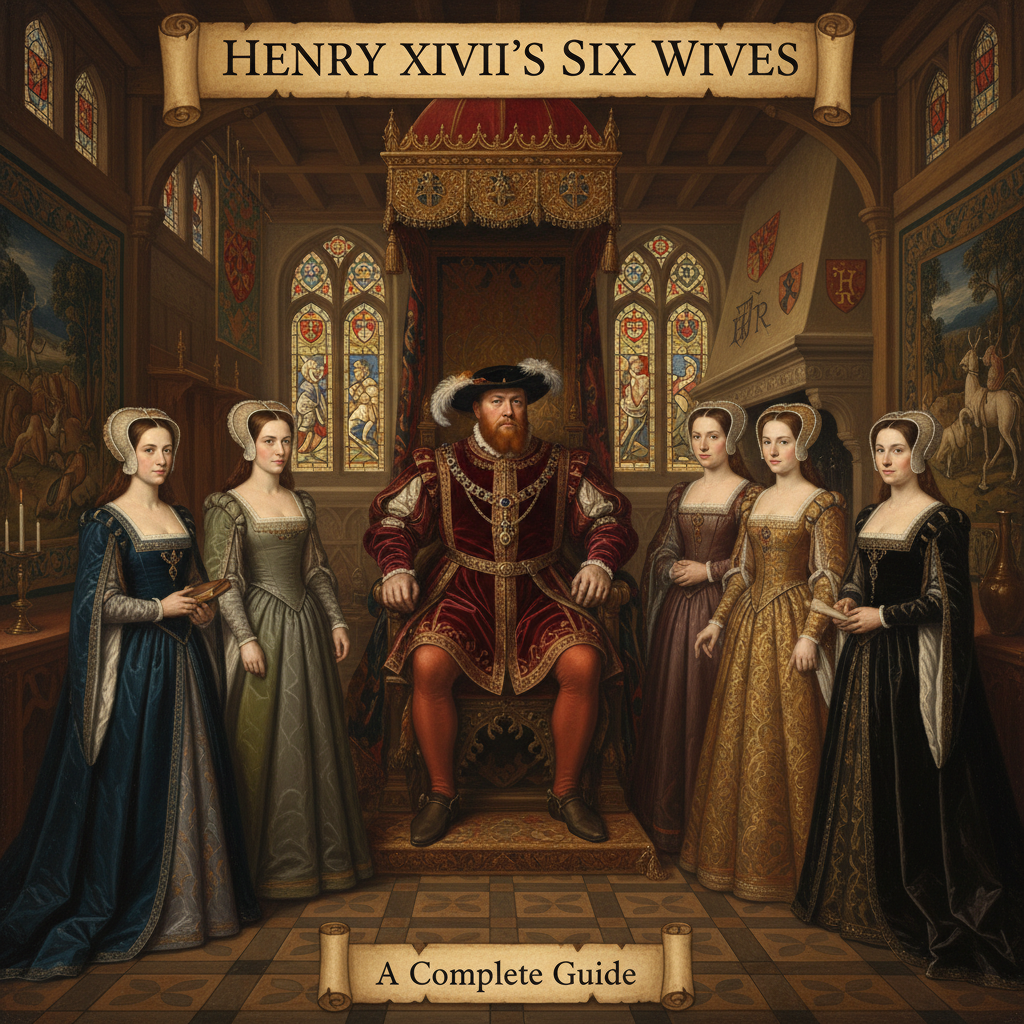
Few monarchs in history captivate the imagination quite like Henry VIII, and at the heart of his tumultuous reign lies the dramatic saga of his six wives. More than just a tale of marital woes, this narrative reshaped England's religion, politics, and social fabric forever. From the devout Spanish princess to the vivacious English noblewoman, the quiet mother of his heir, the short-lived German bride, the scandalous young queen, and finally, the wise widow, each woman played a pivotal role in the unfolding drama of the Tudor court. Join us as we delve into the lives, loves, and legacies of these remarkable women, whose destinies were inextricably linked to one of history's most formidable kings.
The King's Great Matter: A Dynasty in Peril
Henry VIII ascended the throne in 1509, a handsome, athletic, and intelligent young king, full of promise. His marriage to Catherine of Aragon, his elder brother Arthur's widow, initially seemed blessed. For over two decades, they shared a throne, a bed, and a deep intellectual bond. However, as the years passed, a critical problem emerged: the lack of a male heir. While Catherine bore several children, only one, Princess Mary, survived infancy. In an age where a stable succession was paramount to preventing civil war, Henry grew increasingly desperate.
He became convinced that his marriage was cursed, citing Leviticus 20:21: 'If a man takes his brother's wife, it is an impurity; he has uncovered his brother's nakedness; they shall be childless.' Despite a papal dispensation having been granted for their marriage, Henry's conscience, or perhaps his desire for a son, led him to believe it was invalid in God's eyes. This conviction, coupled with his burgeoning affection for the charismatic Anne Boleyn, ignited what became known as 'The King's Great Matter' – a quest for an annulment that would shatter England's ties with Rome and forever alter the course of its history.
"His Majesty, being moved by the Spirit of God, and having had his conscience touched by the words of Holy Scripture, has taken it into his head that his marriage with the Queen is not valid."
— Cardinal Wolsey, on Henry VIII's growing conviction.
Did You Know?
Before Anne Boleyn, Henry VIII had an affair with her elder sister, Mary Boleyn. This fact added another layer of complexity and scandal to his pursuit of Anne, as it was considered incestuous by some religious interpretations.
Catherine of Aragon: The Steadfast Queen (1509-1533)
Catherine of Aragon, daughter of the formidable Ferdinand and Isabella of Spain, was a queen of immense dignity, intelligence, and piety. Her marriage to Henry VIII lasted for 24 years, making her his longest-serving queen. She was a cultured woman, well-educated, and a capable regent when Henry was away fighting in France. She bravely led England's defence against the Scots at the Battle of Flodden in 1513, a testament to her strength.
When Henry sought to annul their marriage, Catherine fought fiercely and eloquently to defend her status and the legitimacy of her daughter, Mary. She appealed directly to the Pope and refused to acknowledge the authority of any English court to judge her marriage. Her unwavering resolve in the face of immense pressure earned her widespread public sympathy, even as Henry's court turned against her.
- Born: December 16, 1485, Alcalá de Henares, Spain
- Married Henry VIII: June 11, 1509
- Children: Mary I (and several others who died in infancy)
- Annulled: May 23, 1533
- Died: January 7, 1536, at Kimbolton Castle
Her refusal to yield ultimately led to her banishment from court and separation from her daughter. She died in isolation, still proclaiming herself Henry's rightful queen, a tragic figure whose steadfastness remains a powerful symbol of resilience.
Anne Boleyn: The Catalyst for Change (1533-1536)
Anne Boleyn, a lady-in-waiting to Queen Catherine, was unlike any queen England had seen before. Intelligent, witty, and with a captivating charm, she refused to become Henry's mistress, holding out for marriage and the crown. Her ambition, combined with Henry's infatuation and his desire for a male heir, became the driving force behind the English Reformation.
To marry Anne, Henry broke with the Roman Catholic Church, declared himself Supreme Head of the Church of England, and had his marriage to Catherine annulled by Archbishop Thomas Cranmer. Anne was crowned Queen in June 1533, and in September, she gave birth to a daughter, Elizabeth, who would one day become one of England's greatest monarchs. However, the longed-for son did not materialise, and Henry's affections began to wane.
- Born: c. 1501/1507, Blickling Hall or Hever Castle, England
- Married Henry VIII: January 25, 1533 (secretly); May 28, 1533 (publicly)
- Children: Elizabeth I
- Executed: May 19, 1536, at the Tower of London
Anne's reign was short and turbulent. Her outspoken nature and involvement in political and religious reforms made her many enemies. When she failed to produce a male heir and suffered several miscarriages, Henry's patience ran out. In a dramatic fall from grace, she was accused of adultery, incest, and treason – charges widely believed to be fabricated – and was executed at the Tower of London in May 1536. Her death paved the way for Henry's next marriage and further solidified the break with Rome.
Jane Seymour: The Beloved Queen (1536-1537)
Just eleven days after Anne Boleyn's execution, Henry VIII married Jane Seymour, a quiet and demure lady-in-waiting from a prominent gentry family. Jane was seen by many as the antithesis of Anne, embodying the traditional virtues of modesty and obedience. She quickly provided Henry with what he most desperately craved: a healthy male heir, Prince Edward, born in October 1537.
The birth of Edward was a moment of immense national celebration and relief, securing the Tudor dynasty. Henry was overjoyed, and Jane was truly his 'beloved wife,' having fulfilled her primary duty as queen. However, the joy was short-lived. Just twelve days after Edward's birth, Jane succumbed to puerperal fever (childbed fever).
"God hath given us a prince, by a most excellent and virtuous lady, who hath now departed to God, to our great heaviness."
— Henry VIII, on the death of Queen Jane Seymour.
- Born: c. 1508, Wulfhall, Wiltshire, England
- Married Henry VIII: May 30, 1536
- Children: Edward VI
- Died: October 24, 1537, at Hampton Court Palace
Henry genuinely mourned Jane, declaring her his only true wife. He was buried beside her in St. George's Chapel, Windsor Castle, a testament to the profound impact she had on him by giving him his longed-for son. Her brief reign is often remembered as a period of relative calm after the storm of Anne Boleyn's downfall.
Anne of Cleves: The Unloved Queen (1540)
Following Jane Seymour's death, Henry remained a widower for over two years. His chief minister, Thomas Cromwell, sought to secure an alliance with Protestant German states and arranged a marriage with Anne of Cleves, sister of the Duke of Cleves. The marriage was based on a portrait by Hans Holbein the Younger, which reportedly flattered Anne considerably.
When Anne arrived in England, Henry was deeply disappointed by her appearance, famously declaring, "I like her not!" He found her unattractive and struggled to consummate the marriage. The union was a political and personal disaster, lasting only six months before it was annulled on the grounds of non-consummation and a pre-contract with another nobleman.
- Born: September 22, 1515, Düsseldorf, Duchy of Cleves
- Married Henry VIII: January 6, 1540
- Annulled: July 9, 1540
- Died: July 16, 1557, at Chelsea Old Manor, England
Unlike Catherine or Anne Boleyn, Anne of Cleves wisely accepted the annulment and was granted a generous settlement, including several estates and the title of 'The King's Beloved Sister.' She remained in England, outliving Henry and all his other wives, a testament to her pragmatic approach to a difficult situation.
Catherine Howard: The Young and Reckless Queen (1540-1542)
Barely three weeks after his annulment from Anne of Cleves, Henry married the young and vivacious Catherine Howard, a cousin of Anne Boleyn. Henry, now in his late forties and increasingly corpulent, was infatuated with the youthful Catherine, who brought a renewed sense of joy and vitality to the aging king.
However, Catherine's past was not as pristine as her public image suggested. Before her marriage to Henry, she had engaged in flirtations and sexual relationships, which, while common for young women of her age, were considered treasonous for a queen. Her indiscretions continued after her marriage, including an affair with Thomas Culpeper, a gentleman of the King's Privy Chamber.
- Born: c. 1523/1525, Lambeth, England
- Married Henry VIII: July 28, 1540
- Executed: February 13, 1542, at the Tower of London
When news of her pre-marital and marital affairs reached Henry, he was devastated and enraged. The charges against her were adultery and treason. Like her cousin Anne Boleyn, Catherine Howard met her end on the scaffold at the Tower of London, a tragic victim of her own youthful indiscretions and the unforgiving strictures of the Tudor court.
Catherine Parr: The Surviving Queen (1543-1547)
Henry VIII's sixth and final wife was Catherine Parr, a wealthy widow who had already been married twice. She was a woman of intellect, piety, and considerable political skill. By the time Henry married Catherine in 1543, he was ailing, overweight, and increasingly difficult. Catherine brought a much-needed sense of stability and domestic harmony to the royal household.
She was a devoted stepmother to Henry's three children – Mary, Elizabeth, and Edward – fostering a warm and intellectual environment that allowed them to thrive. She was also a keen reformer, publishing several religious works, and even dared to debate theology with the King, a dangerous pastime given Henry's volatile temper.
- Born: August 1512, Blackfriars, London, England
- Married Henry VIII: July 12, 1543
- Died: September 5, 1548, at Sudeley Castle, England
Catherine Parr successfully navigated the treacherous waters of the Tudor court, surviving Henry VIII by a year and a half. She played a crucial role in reconciling Henry with his daughters, Mary and Elizabeth, ensuring their places in the succession. Her intelligence, resilience, and compassionate nature made her a fitting final queen for the aging, formidable king. She represents the culmination of Henry's marital journey, a testament to survival and influence in a world dominated by male power.
Conclusion: The Enduring Legacy of Henry's Wives
The story of Henry VIII's six wives is more than a series of personal tragedies; it is a lens through which we can understand the seismic shifts of the Tudor era. These women, each unique in their character and fate, were instrumental in shaping the English Reformation, influencing royal succession, and defining the role of queenship. From Catherine of Aragon's steadfast defiance to Anne Boleyn's revolutionary impact, Jane Seymour's dynastic gift, Anne of Cleves' pragmatic survival, Catherine Howard's tragic fall, and Catherine Parr's intellectual and nurturing influence, their stories continue to fascinate and inform our understanding of one of history's most pivotal periods. Their lives, intertwined with the destiny of a powerful king, remind us that even amidst grand political machinations, human drama, ambition, love, and loss remain at the heart of history. To explore more about the Tudor dynasty and its fascinating figures, continue reading our articles on The English Reformation and The Early Life of Elizabeth I.
TAGS
Discussion
No comments yet
Be the first to share your thoughts on this article!
You May Also Like
Continue exploring Tudor history with these related articles

Catherine Parr: The Survivor Queen and Royal Reformer
Catherine Parr, the sixth and final wife of Henry VIII, was a scholar, reformer, and political survivor. Discover how she navigated the treacherous Tudor court, escaped execution, and profoundly influenced the education of the future Elizabeth I and Edward VI.

Greenwich Palace: The Lost Cradle of Tudor Royalty
Discover the lost grandeur of Greenwich Palace (Placentia), the primary residence and crucial birthplace of the Tudor dynasty. This comprehensive article explores how Henry VII established the palace, the spectacular court life under Henry VIII, and its vital role as the birthplace of Henry VIII, Mary I, and Elizabeth I, before its eventual replacement by the Old Royal Naval College.

Edward VI: The Tragic Reign of the Boy King
Edward VI, the only son of Henry VIII and Jane Seymour, ascended the throne at age nine. His brief but transformative reign (1547–1553) saw the radical acceleration of the English Reformation, fundamentally shaping the religious identity of England despite his tragic early death.

Bosworth Field: How Henry VII Won the Crown and Began the Tudor Dynasty
Explore the dramatic Battle of Bosworth Field (1485), where Henry Tudor, the unlikely challenger, defeated Richard III, ending the Wars of the Roses and ushering in the powerful and enduring Tudor dynasty.